
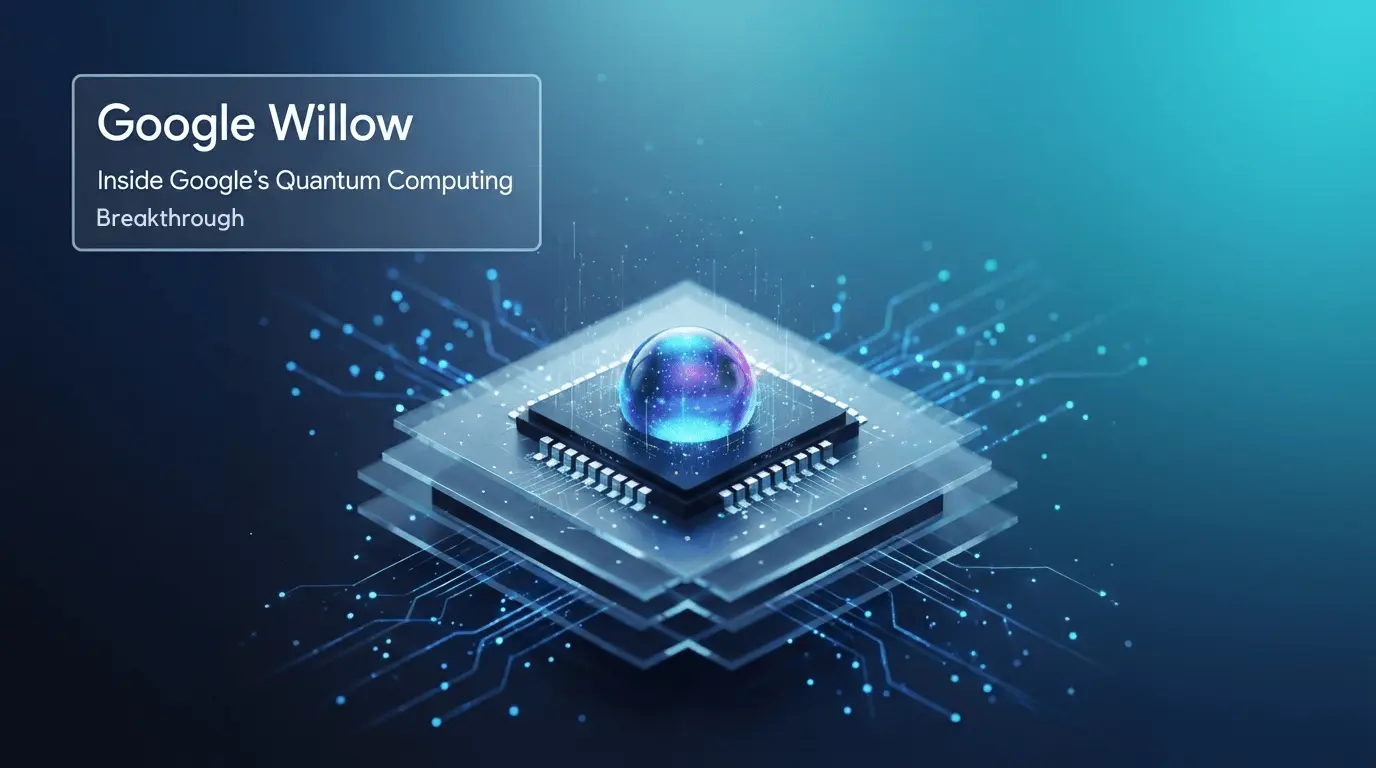
What Is Google Willow?
Google Willow is a new advanced computing chip developed by Google as part of its long-term work in quantum computing. It is designed to solve complex problems that are extremely difficult — or nearly impossible — for traditional computers.
In simple terms, Willow is not a normal computer chip.
It is built to work with quantum technology, which processes information in a completely different way compared to today’s CPUs and GPUs.
Why Is Google Willow Important?
Google Willow is important because it represents a major step forward in practical quantum computing.
Traditional computers:
Process data using bits (0 or 1)
Become slow for extremely complex calculations
Quantum-based systems like Willow:
Use quantum states
Can handle massive calculations faster
Reduce errors that previously limited quantum progress
👉 This means problems that take years on normal computers could eventually take minutes or seconds.
What Can Google Willow Be Used For?
Google Willow is not meant for gaming or everyday apps.
Its potential use cases include:
Scientific research
Climate modeling
Drug and medicine discovery
Advanced AI training
Cybersecurity and encryption research
Solving large-scale mathematical problems
These are tasks where speed and accuracy are critical.
How Is Google Willow Different From Normal Chips?
The biggest difference is how data is processed.
Normal chips:
Use classical computing logic
Scale by adding more cores
Google Willow:
Uses quantum principles
Focuses on stability and reduced errors
Designed for research and future systems
Willow helps address one of the biggest problems in quantum computing: error correction.
Does Google Willow Mean Quantum Computers Are Ready?
Not yet.
Google Willow is a research breakthrough, not a consumer product.
You won’t see Willow-powered laptops or phones anytime soon.
However, it shows that:
Quantum computing is becoming more stable
Real-world applications are getting closer
Google is serious about long-term quantum leadership
Think of Willow as a foundation, not a finished product.
How Does Google Willow Compare to Other Quantum Chips?
Many companies are working on quantum technology, but Google Willow stands out because:
Google focuses on error reduction
The goal is long-term reliability, not short demos
Willow builds on years of Google quantum research
This makes Willow more about future readiness than short-term hype.
What Does Google Willow Mean for AI?
Quantum computing and AI are closely connected.
In the future, technology like Willow could:
Speed up AI model training
Improve optimization problems
Help build more powerful AI systems
However, current AI tools still run on traditional hardware. Willow represents what may power next-generation AI years from now.
Should Regular Users Care About Google Willow?
Yes — but with patience.
You won’t use Willow directly, but its impact may:
Improve future AI services
Lead to faster scientific discoveries
Influence cloud computing in the long term
Many modern technologies started as research projects like this.
Frequently Asked Questions
What is Google Willow?
Google Willow is an advanced quantum computing chip designed to improve stability and performance in quantum systems.
Is Google Willow a normal CPU or GPU?
No. It is part of quantum computing research and works very differently from traditional processors.
Can consumers buy Google Willow?
No. Willow is a research-focused technology, not a consumer product.
Does Google Willow mean quantum computing is solved?
No. It is a step forward, but quantum computing is still evolving.
When will quantum computing affect everyday users?
Likely in the coming years through cloud services, AI improvements, and scientific breakthroughs.
Final Thoughts
Google Willow is a powerful sign that quantum computing is moving from theory toward real-world progress. While it won’t replace your current computer, it may shape the future of AI, science, and technology in ways we can’t fully see yet.
👉 Willow isn’t about today — it’s about what comes next.

-Who-Wins-the-Satellite-War.webp)



Comments 0
No comments yet
Be the first to share your thoughts!
Leave a Comment