
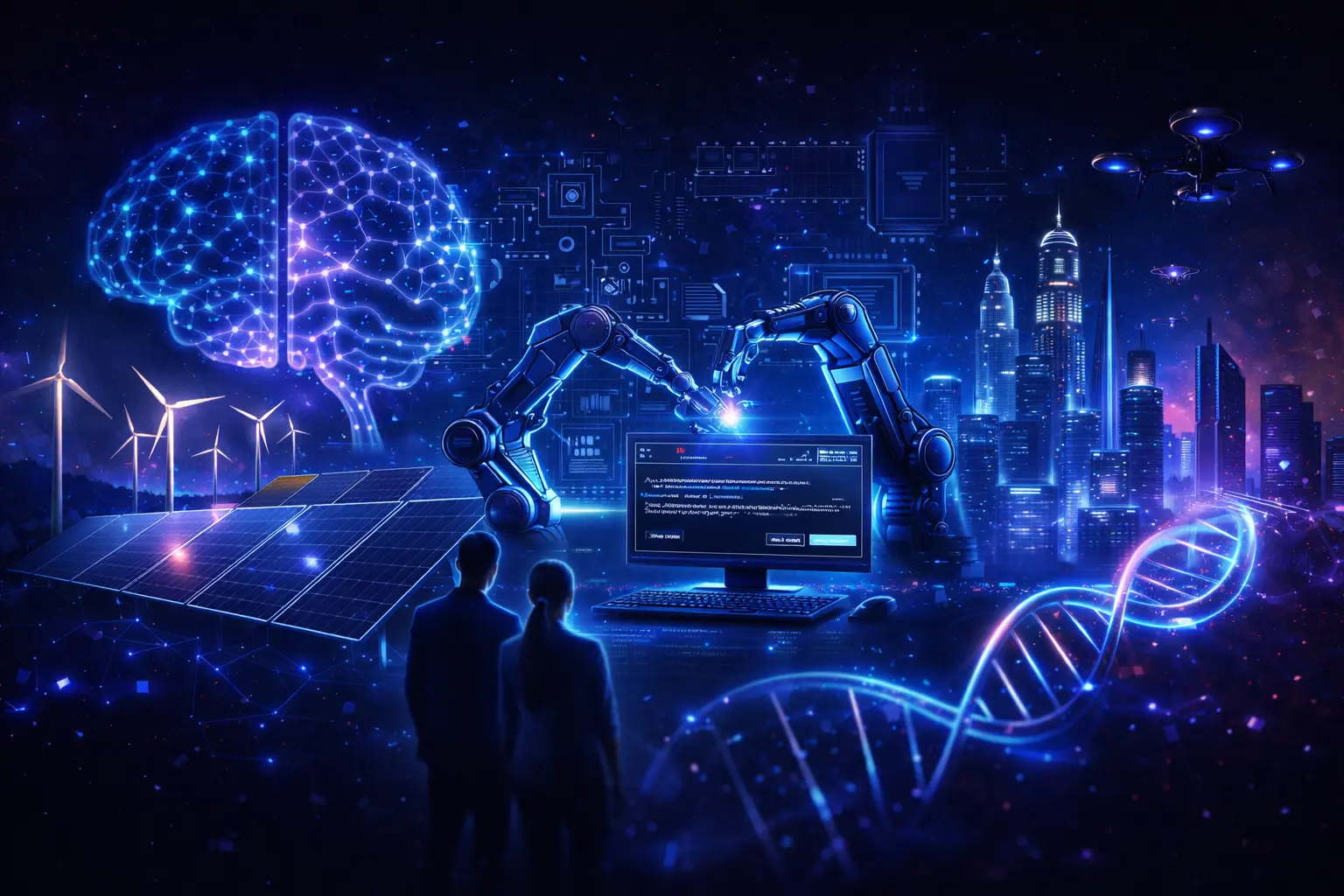
Upcoming technologies like advanced artificial intelligence, quantum computing, synthetic biology, and clean energy systems are set to transform how we work, live, travel, and solve global problems over the next decade. These breakthrough technologies aren't just new gadgets—they represent disruptive technologies that will reshape entire industries, job markets, healthcare systems, and even what it means to be human.
If you're wondering what technologies will change the world by 2030, this comprehensive guide explores the most important emerging technologies for business, society, and the environment.
What Are "Future-Changing" Technologies?
Future tech innovations are foundational technologies that create ripple effects across multiple sectors:
- They reshape job markets and require massive reskilling for future tech careers
- They change how we produce energy, food, medicine, and consumer goods
- They raise new ethical concerns about future technology, privacy, and human enhancement
- They drive digital transformation technologies across every industry
Most experts predict revolutionary technology advancements will come from AI, quantum tech, biotechnology, robotics, climate tech, smart cities, and Web 4.0 decentralization.
1. Next-Generation Artificial Intelligence
Artificial general intelligence (AGI) is still years away, but cutting edge technology 2026 already includes powerful AI systems acting like digital coworkers.
Key Developments in AI Innovation
Generative & Agentic AI
AI technologies that will transform healthcare, finance, and education can now write, code, design, and autonomously plan multi-step tasks. These AI agents collaborate with other systems and humans, becoming true industry copilots embedded in every knowledge workflow.
Edge AI Computing & Federated Learning
AI is moving from cloud data centers to Edge AI computing on devices, phones, and IoT sensors. This approach allows AI models to process data closer to where it is generated, reducing latency and improving privacy. Learn more about Edge AI computing, how it works, benefits, and real-world use cases. Federated learning trains models across distributed devices without centralizing sensitive data, solving privacy concerns.
Neuromorphic Computing
Brain-inspired chips that process information like neurons are enabling ultra-low-power AI for robotics, wearables, and autonomous systems.
Technology Ethics & AI Bias Solutions
Growing focus on explainable AI, audits, and compliance as systems impact loans, hiring, medical diagnosis, and law enforcement. Regulators worldwide are implementing tech policy frameworks for trustworthy AI.
How AI Will Change the Future of Work
AI job displacement solutions focus on augmentation, not replacement. Expect:
- Massive productivity boosts allowing smaller teams to achieve more
- New AI job opportunities in prompt engineering, AI orchestration, safety auditing, and ethics
- Continuous reskilling for future tech as roles shift from execution to supervision and creative problem-solving
2. Quantum Computing and Quantum Cryptography Security
Quantum computing breakthrough is moving from lab experiments into early real-world pilots for finance, logistics, and pharma.
Key Quantum Technology Developments
Quantum Computing Applications
Early systems solve highly complex optimization problems—portfolio management, supply chain routing, molecular simulation—that overwhelm classical supercomputers.
Quantum Simulation for R&D
By modeling atomic interactions with unprecedented precision, quantum systems accelerate discovery of new medicines, fertilizers, batteries, and catalysts.
Quantum Cryptography Security & Tech Sovereignty
Quantum-safe encryption and quantum cryptography security networks are emerging as strategic infrastructure for finance, defense, and government. Nations compete for tech sovereignty in quantum capabilities.
Impact on Industries
Expect breakthroughs in:
- Personalized medicine with AI-quantum hybrid drug design
- Perovskite solar cells and advanced battery chemistry optimized via quantum simulation
- Complete rethinking of cybersecurity as current encryption becomes vulnerable
3. Biotechnology Breakthroughs and Healthcare Tech
Synthetic biology applications are making biology programmable like software, converging AI and biotech.
Key Biotech Innovations
AI-Driven Drug Discovery
Algorithms screen millions of molecules, predict side effects, and design new compounds, slashing R&D costs and time. This is one of the most important emerging technologies for business in pharma.
CRISPR Gene Therapy & Precision Medicine
More precise CRISPR gene therapy tools treat genetic diseases, engineer disease-resistant crops, and potentially slow aging. Personalized medicine uses genetic profiles to tailor treatments.
Organoids & Lab-Grown Tissues
Engineered mini-organs and lab-grown meat reduce animal testing and offer future transplantation options.
Biohacking Technologies & Neural Implants
Wearables, smart patches, biosensors, and even brain computer interface (BCI) technology enable continuous health monitoring and early disease detection. Neural implants and augmented humans raise profound questions about enhancement and equality.
Longevity Technology & Anti-Aging Research
Startups focus on anti-aging research, cellular reprogramming, and senolytics to extend healthy human lifespan.
Impact on Healthcare Systems
Healthcare shifts from reactive to preventive:
- Earlier diagnosis via continuous monitoring
- Telemedicine platforms and remote surgery robotics expand access
- Intense ethical concerns around enhancement, access, and genetic privacy
4. Robotics, Automation, and Spatial Computing
Future of work automation is spreading from factories into logistics, healthcare, agriculture, retail, and homes.
Key Robotics & Automation Technologies
Collaborative Robots (Cobots)
Smart robots work safely alongside humans in warehouses, factories, farms, hospitals, and construction sites. Smart manufacturing 4.0 integrates robots, IoT, and AI for lights-out production.
Service Robots & Accessibility Technology
Robots in retail, hospitality, cleaning, and elder care handle repetitive or hazardous tasks. Accessibility technology helps people with disabilities through assistive robotics.
Precision Agriculture Technology & Vertical Farming
Drones, sensors, and AI-guided robots optimize planting, watering, and harvesting. Vertical farming automation produces food in cities with minimal land and water.
Spatial Computing: AR/VR/XR & Digital Twin Technology
Headsets and smart glasses overlay digital data on the real world for training, remote support, design, and maintenance. Digital twin technology creates virtual replicas of factories, buildings, and cities for simulation and optimization.
Future of Work Impact
Jobs shift from manual execution to:
- Supervising automated systems
- Designing workflows and exceptions
- Predictive maintenance IoT roles monitoring equipment health
- Immersive training via spatial computing
5. Clean Energy Technologies and Climate Tech
Climate adaptation technology and carbon negative technology are driving rapid innovation to meet net-zero targets.
Key Clean Energy Innovations
Next-Gen Batteries & Energy Storage
Hydrogen fuel cells, solid-state batteries, sodium-ion, and flow batteries make EVs cheaper, safer, and enable reliable grid storage. Perovskite solar cells promise cheaper, flexible solar panels.
Carbon Capture & Direct Air Capture Technology
Direct air capture technology and industrial carbon capture systems move from prototypes to larger pilots in cement, steel, and power generation.
Fusion Energy Breakthrough
Private fusion startups and government labs approach net energy gain, potentially revolutionizing baseload power by the 2030s.
Green Tech Innovations: Hydrogen & Smart Grids
Green hydrogen production via electrolysis powers heavy industry and transport. AI-optimized smart grids balance renewables, storage, and demand in real time.
Advanced Materials & Circular Economy Technology
Graphene, metamaterials, bio-based plastics, and nano-coatings create lighter, stronger, recyclable products. Circular economy technology tracks materials through blockchain supply chains.
Impact on Sustainability
These sustainable technology innovations enable:
- Decarbonized transport, industry, and buildings
- Tech for social good addressing climate, energy access, and resource efficiency
- New green tech business models and regulations mandating disclosure
6. Future Mobility and Smart City Technologies
Transportation innovations and smart city technologies are reshaping urban life.
Key Developments
Autonomous Vehicles & Connected Cars
Self-driving features roll out gradually for logistics, trucking, and ride-hailing. Safety, liability, and regulatory challenges for emerging tech remain.
Urban Air Mobility & Drones
Delivery drones and air taxis for short-range passenger routes emerge in dense cities.
Smart Cities & IoT Infrastructure
Sensors, 5G, and AI coordinate traffic, lighting, water, waste, and emergency services. Innovation ecosystems and tech hubs worldwide compete to build model smart cities.
5G Technology & Edge Computing
Ultra-low-latency 5G technology enables real-time control of vehicles, robots, and city infrastructure via edge computing nodes.
Trade-Offs and Challenges
Smart cities offer efficiency and lower emissions but raise concerns about:
- Privacy enhancing technology vs. surveillance
- Algorithmic bias in policing and services
- Digital divide solutions ensuring equity
7. Web 4.0, Blockchain Supply Chain, and Decentralization
The next internet wave focuses on trust, ownership, and interoperability beyond hype.
Key Web 4.0 Developments
Decentralized Identity & Privacy
Users control cryptographic IDs and data vaults, choosing what to share. Privacy enhancing technology like zero-knowledge proofs protects sensitive info.
Blockchain Supply Chain & Tokenization
Mature blockchain supply chain platforms track provenance, verify authenticity, and enable fractional ownership of assets.
Metaverse 2.0 & Persistent 3D Spaces
Less gaming hype, more focus on inclusive design tech for work, learning, training, and simulation in persistent virtual environments.
Web 4.0 vs Web 3.0 Differences
Web 4.0 emphasizes AI integration, semantic data, and cross-platform identity, while Web 3.0 focused on blockchain ownership.
Impact on Digital Economy
New models around:
- Digital asset ownership and creator economies
- Cross-platform interoperability
- User control reducing dependence on big tech platforms
8. Convergence: The Real Driver of Exponential Technologies
The most transformative technologies emerge when these systems combine.
Powerful Convergence Examples
AI + Biotech
Accelerates biotechnology breakthroughs in drug discovery, vaccines, and lab-grown food.
AI + Robotics + IoT
Creates fully automated smart manufacturing 4.0 facilities, warehouses, and farms.
Quantum + Materials + Energy
Designs new catalysts, batteries, and carbon negative technology industrial processes.
Spatial Computing + Web 4.0
Builds persistent, identity-aware virtual spaces linked to real-world assets via digital twin technology.
Climate Tech + Smart Cities
Integrates clean energy technologies, autonomous vehicles, and AI-managed infrastructure for net-zero urban living.
What This Means for Careers and Business
Careers in Emerging Technologies
High-demand roles include:
- AI ethics and safety auditors
- Quantum algorithm developers
- Biotech data scientists
- Climate tech engineers
- Digital twin architects
- Web 4.0 UX designers
Technology Adoption Strategies
Businesses must:
- Experiment early with pilot projects
- Invest in continuous reskilling for future tech
- Balance innovation with technology ethics considerations
- Prepare for regulatory challenges for emerging tech
Investment Opportunities in Future Tech
Tech investment trends and venture capital favor:
- AI infrastructure and tools
- Quantum-as-a-service platforms
- Biotech and longevity startups
- Climate tech and carbon markets
- Unicorn technology companies in automation and Web 4.0
Regional Innovation: Tech Hubs Worldwide
Asia Technology Innovation
China, India, South Korea, and Japan lead in manufacturing automation, 5G deployment, and AI adoption.
European Tech Regulations
EU sets global standards via AI Act, GDPR, and Digital Markets Act, shaping US tech policy and global technology competition.
US Tech Policy 2026
Focus on semiconductor sovereignty, AI safety research, and tech for social good programs.
Innovation Ecosystems
Emerging tech hubs worldwide include Singapore, Tel Aviv, Bangalore, Berlin, and Austin.
How to Prepare for Future Technology Changes
For Individuals:
- Focus on uniquely human skills: creativity, ethics, judgment, and emotional intelligence
- Continuously learn and adapt through online courses, bootcamps, and certifications
- Explore careers in emerging technologies that combine tech with domain expertise
- Stay informed via tech news, research papers, and communities
For Businesses:
- Build technology adoption strategies with clear pilots and success metrics
- Invest in employee reskilling for future tech
- Partner with startups via accelerators and VC
- Establish AI ethics committees and governance frameworks
- Monitor regulatory challenges for emerging tech in your industry
For Policymakers:
- Balance innovation support with technology ethics safeguards
- Address digital divide solutions ensuring equitable access
- Fund research in tech for social good and climate adaptation technology
- Foster innovation ecosystems through education, infrastructure, and incentives
Conclusion: Navigating the Future Tech Landscape
The upcoming technologies that will change the future represent both tremendous opportunities and significant challenges. Success will require balancing disruptive technology adoption with thoughtful governance, ethical frameworks, and inclusive access.
Whether you're a business leader exploring investment opportunities in future tech, a professional considering tech career opportunities, or simply curious about what technologies will change the world by 2030, the key is to stay informed, experiment responsibly, and focus on human-centered outcomes.
The future is not predetermined—it will be shaped by the choices we make today about how we develop, deploy, and govern these breakthrough technologies and beyond.

-Who-Wins-the-Satellite-War.webp)



Comments 0
No comments yet
Be the first to share your thoughts!
Leave a Comment