
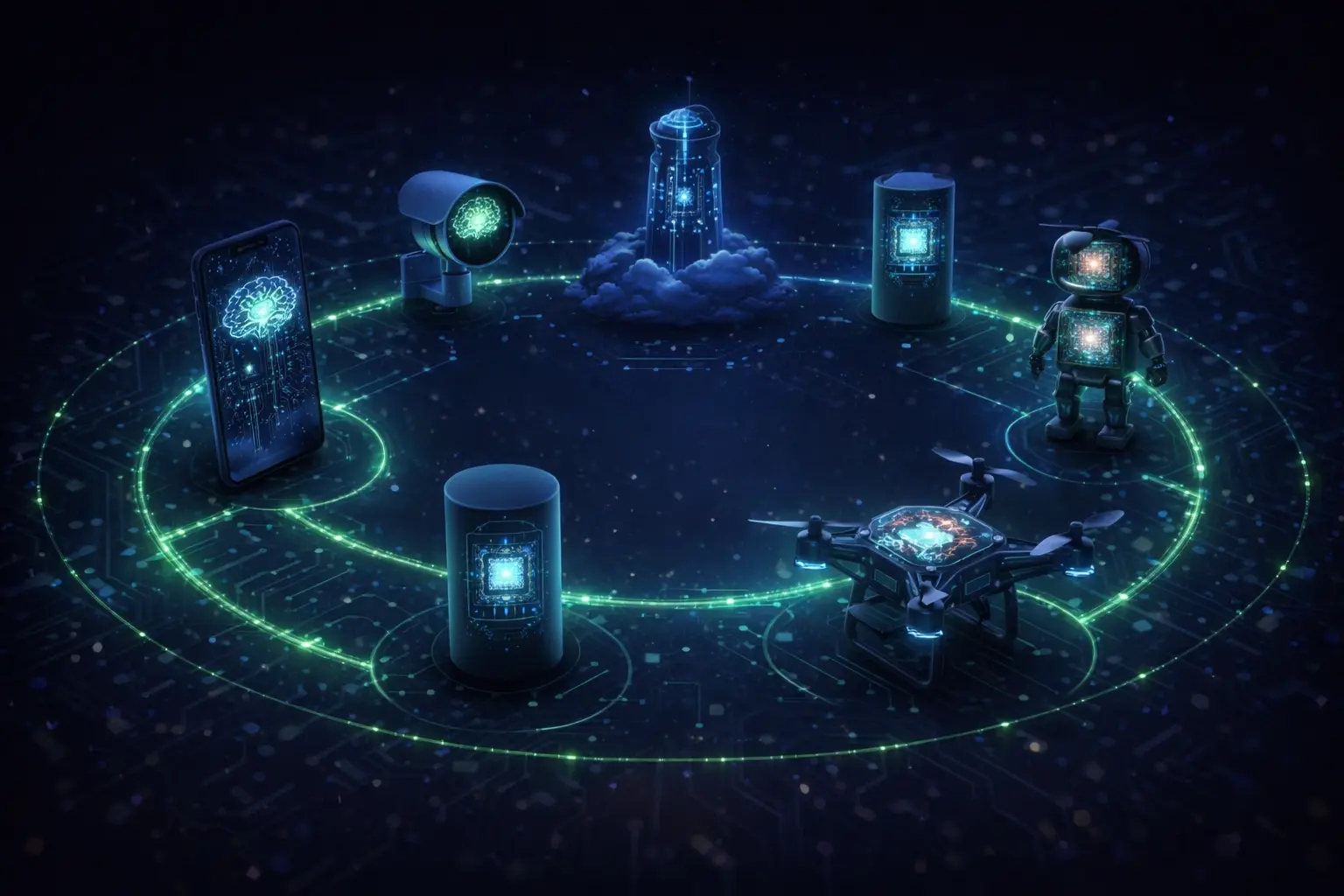
AI on the edge (also called Edge AI computing) is the use of artificial intelligence models directly on local devices such as phones, cameras, sensors, and embedded boards instead of sending all data to a remote cloud server.
What Is AI on the Edge?
AI on the edge means running artificial intelligence models directly on devices or near the source where data is generated instead of sending all data to centralized cloud servers.
This approach allows AI systems to make faster decisions with lower latency, improved privacy, and reduced bandwidth usage. Common examples include smart cameras, smartphones, IoT sensors, autonomous vehicles, and industrial machines that process data locally.
How Does Edge AI Work? (Simple Overview)
Data collection at the edge
Devices like cameras, microphones, and IoT sensors capture raw data.
On-device or near-device processing
Optimized AI models (quantized, pruned, or distilled) run on:
- Smartphones
- Single‑board computers (e.g., Jetson, Raspberry Pi + accelerator)
- Industrial gateways
- Smart cameras, drones, robots
Optional cloud sync
Only selected insights, alerts, or aggregated data are sent to the cloud for storage, analytics, or retraining—rather than raw data streams.
Model updates
New model versions can be pushed from the cloud to edge devices over time.
Edge AI vs Cloud AI
The main difference between Edge AI and Cloud AI is where the AI model runs. Edge AI processes data locally, while Cloud AI sends data to remote servers for processing.
| Feature | Cloud AI | Edge AI |
|---|---|---|
| Where it runs | Remote data center | Local device / gateway |
| Latency | Higher (depends on network) | Very low (near real‑time) |
| Connectivity need | Always/mostly online | Can run offline or intermittent |
| Privacy | Raw data often leaves the device | Data can stay local |
| Compute power | Very high (GPUs, TPUs, clusters) | Limited (specialized chips/accelerators) |
| Typical use cases | Heavy training, big batch analytics | Real‑time control, on‑site inference |
Real-World Examples and Use Cases
1. Smart Cameras and Video Analytics
- Real-time object detection (people, vehicles, defects) in factories, stores, and streets
- Intrusion detection in security systems
- Mask detection, queue length monitoring, heatmaps in retail
2. Industrial IoT and Predictive Maintenance
- Vibration and temperature sensors on machines detect anomalies locally
- Edge gateways run AI models to predict equipment failure
- Only alerts and summaries go to the cloud, saving bandwidth
3. Autonomous Vehicles, Drones, and Robotics
- Self-driving cars process camera, LiDAR, and radar inputs on-board
- Industrial robots adjust movement based on local sensor feedback
- Delivery drones avoid obstacles without constant network access
4. Consumer Devices and Smartphones
- On-device voice assistants and speech recognition
- Offline photo categorization and face unlock
- Real-time AR filters and computer vision effects
5. Healthcare and Smart Hospitals
- Local AI on medical imaging devices for pre-screening (e.g., X-ray anomaly detection)
- Wearables analyzing heart rate, ECG, and movement in real time
- Edge processing in remote or bandwidth-limited clinics
6. Smart Home Devices
- Smart speakers process voice commands locally for faster responses
- Security cameras use Edge AI for real-time monitoring and object detection
- Home automation systems use local AI processing to control devices and respond quickly without relying entirely on cloud servers
Advantages of Edge AI
1. Lower Latency (Real-Time Decisions)
Since data doesn't need to travel to a distant server and back, responses can be near instant.
This is critical for:
- Autonomous vehicles and robots
- Industrial safety systems
- Medical devices in surgery or critical care
2. Better Privacy and Data Security
Because raw data can remain on the device:
- Less sensitive data (faces, voices, health metrics) leaves the device
- Regulatory compliance is easier (GDPR, HIPAA, etc.)
- Attack surface is reduced vs. centralized big data lakes
3. Reduced Bandwidth and Cloud Costs
Streaming high‑resolution video or sensor data 24/7 to the cloud is expensive.
Edge AI allows you to:
- Send only metadata or alerts, not raw feeds
- Operate in locations with limited or expensive connectivity
- Save on recurring cloud compute and storage bills
4. Resilience and Offline Capability
Edge AI systems can continue to operate when:
- Internet is down
- Networks are congested
- Operating in remote locations (ships, mines, rural areas)
This is vital for mission‑critical systems.
Disadvantages and Challenges of Edge AI
1. Limited Compute and Memory
Edge devices are constrained:
- Smaller CPUs, limited RAM, lower power budgets
- Large AI models must be compressed (quantization, pruning)
- Some tasks still too heavy for the edge today
This makes model optimization and hardware selection more complex.
2. Deployment and Management Complexity
Managing thousands of edge devices is harder than a centralized cloud cluster:
- Version control for models and software
- Remote updates and rollbacks
- Monitoring performance and failures at scale
- Security patches across heterogeneous hardware
You often need a proper device management and MLOps strategy for the edge.
3. Higher Upfront Hardware Cost
Compared to a simple sensor streaming to the cloud, intelligent edge devices:
- Need better processors or AI accelerators
- Can be more expensive to design, test, and maintain
Though cloud savings may offset this over time, initial CAPEX can be high.
4. Security Risks at the Edge
While data is more local, each device is a potential attack target:
- Physical access (tampering, theft)
- Local exploitation of outdated firmware or OS
- Need for secure boot, encryption at rest, and strong authentication
So edge deployments require robust security best practices.
Typical Edge AI Hardware and Platforms
- Embedded AI modules: NVIDIA Jetson, Google Coral, Intel Movidius
- Smartphones & tablets: Snapdragon, Apple Silicon with neural engines
- Industrial gateways: Ruggedized x86/ARM systems with accelerators
- Custom ASICs: Dedicated chips for vision, speech, or sensor processing
Frameworks and tools often include optimized runtimes like TensorRT, ONNX Runtime, Core ML, and mobile/embedded versions of PyTorch/TensorFlow.
When Should You Use Edge AI vs Cloud AI?
Edge AI is ideal when:
- You need millisecond‑level latency
- You must protect sensitive data locally
- Network connectivity is unreliable or expensive
- You're doing continuous high volume sensing (video, audio, telemetry)
Cloud AI is better when:
- You're training large models
- You need to analyze huge historical datasets
- Latency is not critical
- Centralized data makes more sense operationally
In practice, the strongest systems combine both: training and heavy analytics in the cloud, with fast inference at the edge.
How Edge AI Fits Into the Future Tech Landscape
In our guide to upcoming technologies that will change the future, Edge AI is a key enabler for:
- Smart cities and infrastructure
- Autonomous vehicles and drones
- Industry 4.0 and predictive maintenance
- Real-time healthcare monitoring
- Privacy-preserving AI experiences on consumer devices
It is one of the core building blocks that turns AI from something that only lives in data centers into something that lives everywhere around us in cameras, vehicles, factories, and homes.
Frequently Asked Questions
What is the difference between AI and Edge AI?
Traditional AI often relies on cloud servers to process data, while Edge AI runs AI models directly on devices or near the data source. Edge AI enables faster responses, lower latency, and improved privacy by processing data locally.
Does Edge AI work without internet?
Yes. Edge AI can work without a constant internet connection because AI models can run directly on local devices. However, some systems may still use cloud connectivity for model updates, data storage, or advanced analytics.
Is Edge AI better than Cloud AI?
Edge AI is not always better than Cloud AI. Edge AI is ideal for applications that require low latency, real-time decisions, privacy, or limited connectivity. Cloud AI is better for large-scale data processing, model training, and tasks that require significant computing power.
What devices use Edge AI?
Edge AI is used in many devices, including smart cameras, smartphones, smart speakers, IoT sensors, autonomous vehicles, drones, industrial machines, and healthcare monitoring devices.
Conclusion
Edge AI is changing how artificial intelligence is used by moving AI processing closer to where data is created. By running AI models on devices such as smartphones, cameras, sensors, and industrial machines, Edge AI enables faster decisions, lower latency, improved privacy, and reduced dependence on cloud connectivity.
While Cloud AI remains important for large-scale processing and model training, Edge AI is becoming essential for real-time applications such as autonomous systems, smart devices, healthcare monitoring, and industrial automation.
As AI continues to expand into everyday devices, Edge AI will play a key role in bringing intelligent decision-making closer to users and the physical world.
-Specs,-Price,-and-6000-Series-Leaks.webp)
.webp)
Comments 0
No comments yet
Be the first to share your thoughts!
Leave a Comment