
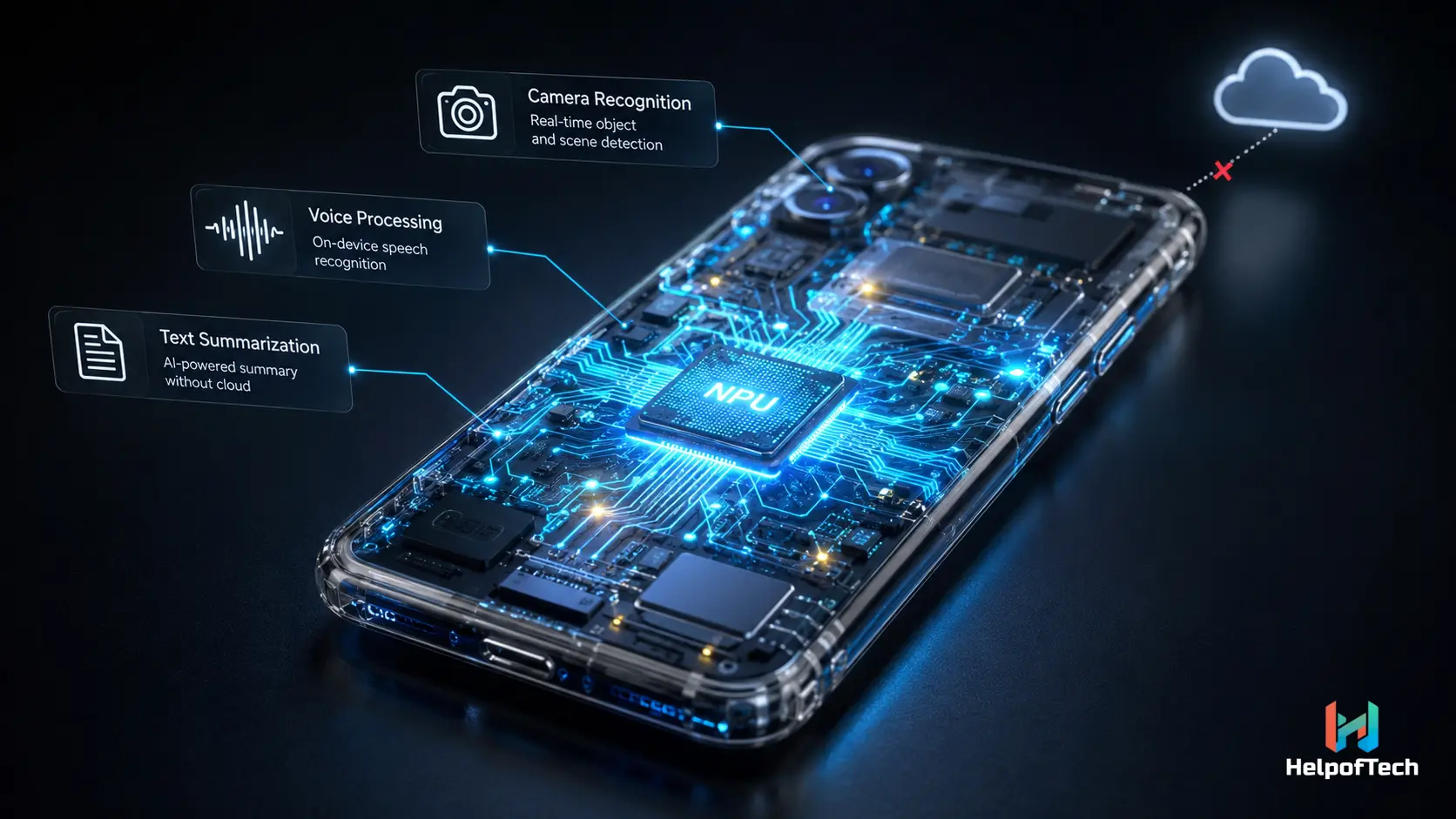
What Is AI on the Edge?
Artificial intelligence is usually associated with large cloud servers. When you ask an AI chatbot a question, upload an image for analysis, or use an online AI tool, your request is often processed by powerful computers in a data center.
AI on the Edge, also known as Edge AI, takes a different approach.
Instead of sending every piece of information to a remote cloud server, Edge AI allows AI models to process data closer to where the data is created. In some cases, the AI model can run directly on the device itself.
For example, imagine a security camera that can recognize a person. With a traditional cloud-based system, the camera may send video to a remote server, where the AI analyzes it and sends the result back.
With Edge AI, the camera or an associated local device can perform the AI processing locally.
That simple difference can make AI applications faster, more private, and less dependent on an internet connection.
How Does Edge AI Work?
The basic process is relatively simple.
A device collects information using sensors, cameras, microphones, or other hardware. An AI model then analyzes that information locally and produces a result.
A traditional cloud AI system may look like this:
Device → Internet → Cloud Server → AI Processing → Internet → Device
An Edge AI system can instead work like this:
Device → Local AI Processing → Result
The device may contain a CPU, GPU, or dedicated Neural Processing Unit (NPU) capable of running AI workloads.
Modern AI development platforms are increasingly designed around this idea. Google's AI Edge platform, for example, provides tools for deploying machine-learning and AI models directly on devices, including smartphones and embedded hardware.
Why Is AI Moving Toward the Edge?
The amount of data generated by devices is increasing rapidly.
Smartphones, cameras, vehicles, smart home devices, industrial sensors, and wearable devices continuously generate information.
Sending all of that data to cloud servers can create several challenges.
There may be network latency, bandwidth requirements, privacy concerns, and cloud processing costs.
Edge AI provides another option: process at least some of the information locally and send only what is necessary to the cloud.
This does not mean cloud AI is disappearing.
Instead, the future is likely to involve a combination of cloud AI and Edge AI, with each handling the tasks it is best suited for.
What Can Edge AI Do?
Edge AI can be used for many different tasks.
- A smartphone can use an on-device AI model to summarize information, process images, or assist with writing.
- A security camera can detect people, vehicles, or unusual activity.
- A wearable device can analyze sensor information.
- An industrial machine can detect unusual patterns before a mechanical problem becomes serious.
Google already supports on-device AI through its AI Edge technologies, including tools for deploying models across Android, iOS, web, and embedded devices.
Advantages of AI on the Edge
Faster Response Times
Because data does not always have to travel to a remote server, Edge AI can reduce latency.
This can be particularly useful for applications where immediate responses matter.
Better Privacy
Sensitive information can potentially remain on the device instead of being uploaded to the cloud.
For example, an AI feature on a smartphone can process certain information locally without sending the raw data away from the device. Google has highlighted this benefit for on-device models such as Gemini Nano.
Less Dependence on Internet Connectivity
An Edge AI application may continue performing certain tasks even when internet connectivity is poor or unavailable.
Lower Cloud Workload
Processing information locally can reduce the amount of data that needs to be transmitted and processed remotely.
Useful for Small Devices
Modern NPUs and optimized AI models are making AI processing possible on smaller and lower-power hardware.
In 2026, companies such as Nordic Semiconductor and Texas Instruments are expanding hardware designed specifically for efficient Edge AI workloads.
Limitations of Edge AI
Edge AI is not perfect.
A smartphone or IoT device has much less processing power, memory, and energy available than a large cloud data center.
AI models therefore often need to be optimized before they can run efficiently on edge hardware.
Developers also need to consider hardware compatibility, model size, battery consumption, security, and software updates.
This is one reason cloud AI remains important for very large models and computationally intensive tasks.
Edge AI Is Not Replacing Cloud AI
One common misunderstanding is that Edge AI will completely replace cloud computing.
That is unlikely.
A better way to think about it is hybrid AI.
A device can perform quick and privacy-sensitive tasks locally while sending more complex workloads to a cloud server.
This combination can provide the advantages of both approaches.
Why Edge AI Matters in 2026
The technology is becoming more practical because AI hardware is improving.
Google is actively developing tools for on-device AI and on-device language models, while chip manufacturers are adding dedicated NPUs to smaller devices.
Nordic Semiconductor, for example, announced Edge AI hardware aimed at battery-powered IoT devices, while Texas Instruments introduced microcontrollers with integrated NPU technology for Edge AI applications.
This suggests that AI is not only becoming more powerful. It is also becoming more distributed.
Final Thoughts
AI on the Edge means bringing AI processing closer to the device where data is created.
Instead of relying entirely on remote servers, devices can perform some AI tasks locally.
That can provide faster responses, improved privacy, reduced network dependence, and potentially lower cloud workloads.
The next stage of AI may therefore not simply be about bigger models. It may also be about putting smaller, smarter, and more efficient models directly into the devices people use every day.
.webp)
Comments 0
No comments yet
Be the first to share your thoughts!
Leave a Comment