
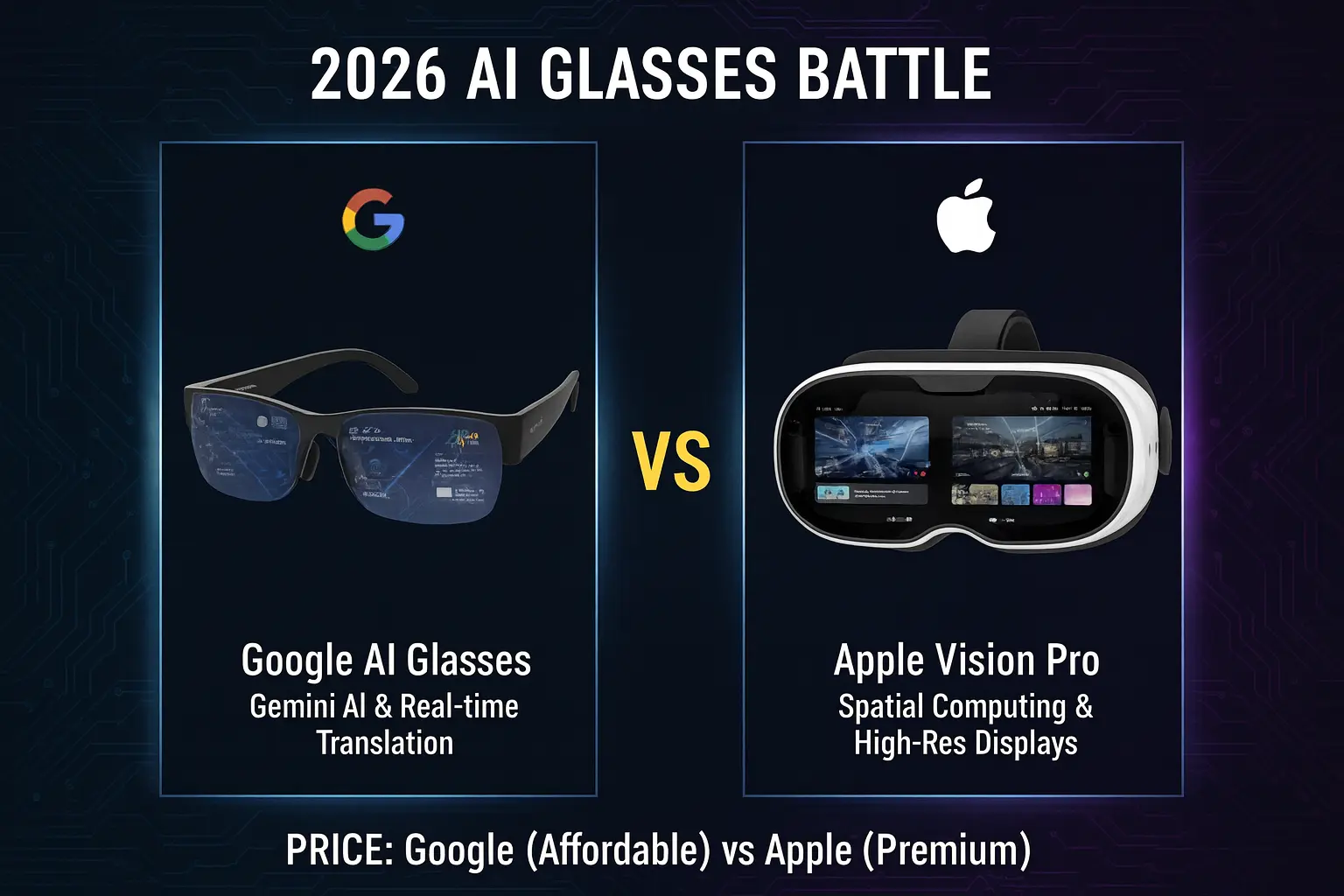
Google is preparing a massive comeback in the smart glasses market with the planned release of its first dedicated AI Glasses in 2026. Unlike the earlier, controversial Google Glass project, this new iteration is designed from the ground up to integrate Gemini AI capabilities, offering real-time assistance, translation, and spatial computing features.
This launch directly sets up a competitive battle with Apple’s Vision Pro, but Google is expected to focus on a significantly different strategy: usability, daily wear, and a much more accessible price point.
1. Core AI Functionality: The Gemini Engine
The entire experience will be powered by Google’s Gemini AI model, focusing on non-intrusive, contextual awareness.
Real-Time Contextual Help: The glasses will utilize spatial computing to understand the user's environment. For example, looking at a device might instantly display the manual on the lens, or looking at a dish in a restaurant might provide real-time translation and reviews.
Instant Translation: The signature feature is expected to be real-time language translation displayed as subtitles over a foreign speaker, making seamless communication effortless.
Hands-Free Interaction: The primary interface will rely on voice commands and simple gesture controls, moving far beyond traditional smartphone input methods.
2. Design and User Experience
Google understands that the failure of the first Google Glass was partly due to its divisive design. The new AI Glasses are expected to prioritize subtlety.
Standard Glasses Form Factor: Leaks suggest the design will resemble a thicker pair of standard reading glasses, making them more socially acceptable for daily use than bulkier headsets.
Focus on the User: The design is expected to avoid large, outward-facing cameras, addressing the privacy concerns that plagued the original Glass model.
All-Day Wear: Battery life and comfort will be paramount, aiming for all-day use rather than short, heavy sessions.
3. The Vision Pro Challenge: Price and Accessibility
While Apple’s Vision Pro established the high-end market for "spatial computing," Google is expected to target the mainstream consumer.
Accessible Pricing: Analysts predict the Google AI Glasses will launch at a price point significantly lower than the Vision Pro's $3,500+ tag. The goal is mass adoption, not niche technology.
Purpose Difference: Where Vision Pro is positioned as a productivity and entertainment device (replacing monitors and TVs), Google’s product will focus purely on information accessibility and daily augmentation.
4. Expected Release Timeline
While the official announcement is still pending, the glasses are widely anticipated to hit the market in early to mid-2026.
The launch will likely be tied to a major Google event, such as the Google I/O 2026 Developer Conference, allowing the company to showcase the deep integration with the Android and Gemini ecosystems.
Conclusion: A New Era of Ambient Computing
The Google AI Glasses represent a shift from screen-centric computing to ambient computing, where information is delivered contextually, exactly when and where you need it. If Google can deliver on its promise of subtle design, powerful Gemini AI, and mainstream pricing, its 2026 glasses could become the first successful mass-market successor to the smartphone.

-Who-Wins-the-Satellite-War.webp)



Comments 0
No comments yet
Be the first to share your thoughts!
Leave a Comment