
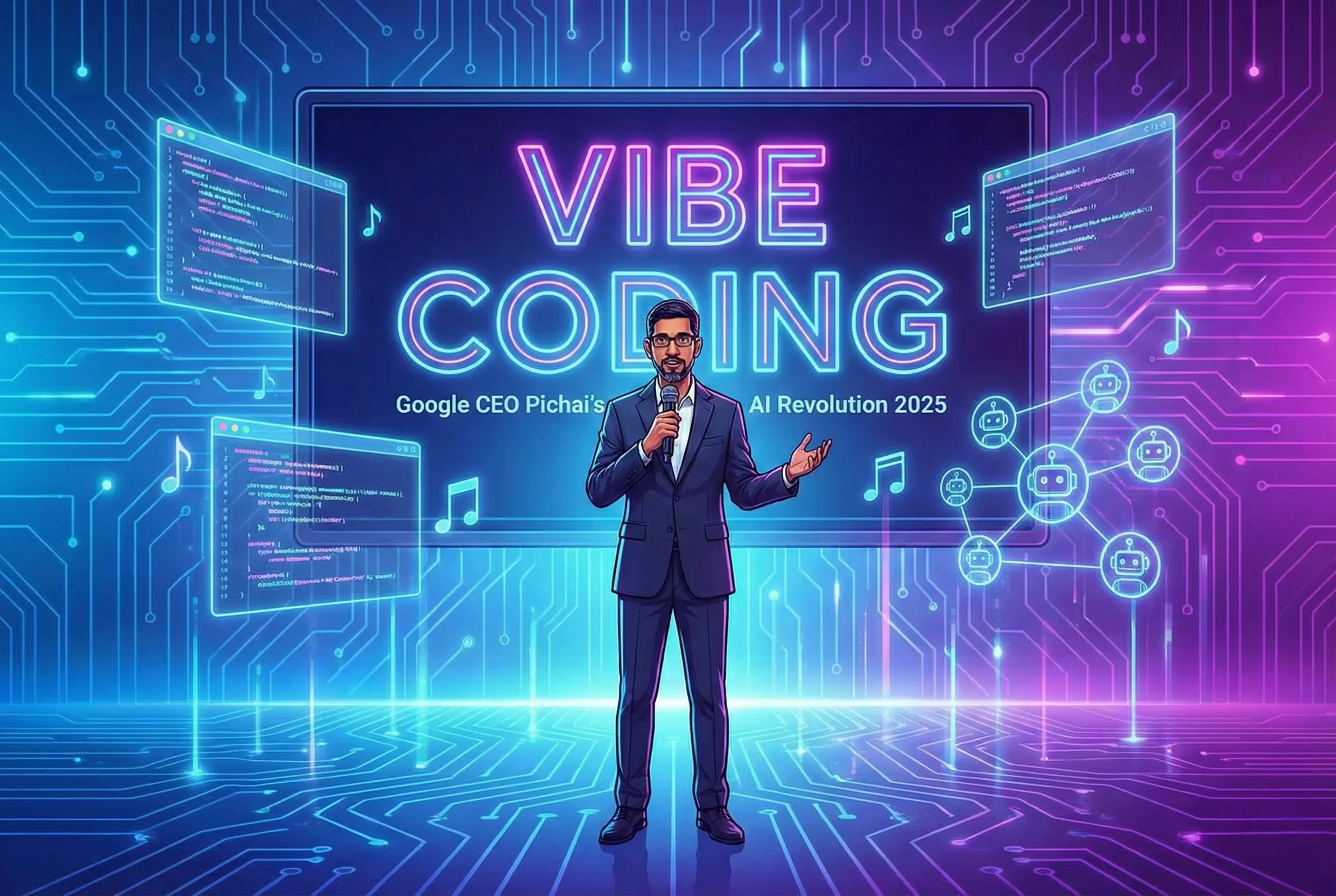
The Viral Trend Taking Silicon Valley By Storm
Imagine building a fully functional app without writing a single line of traditional code. Sounds impossible, right? Well, Google CEO Sundar Pichai thinks this is not just possible—it's the future of software development. In a recent podcast interview with Logan Kilpatrick on Google for Developers, Pichai enthusiastically endorsed a groundbreaking trend called "vibe coding" that's completely changing how we think about programming.
So what exactly is vibe coding, and why is one of the world's most powerful tech leaders so excited about it? Let's break it down.
What Exactly is Vibe Coding?
Vibe coding is essentially the practice of describing what you want to build in plain, everyday language to an AI-powered platform—and watching the AI transform your ideas into actual working code. Think of it like having a conversation with a really smart assistant who happens to be a coding genius.
Instead of spending months learning Python, JavaScript, or other complex programming languages, you simply tell an AI tool something like: "I want to create a to-do list app with a blue background and notification reminders." The AI then generates the necessary code, handles the technical complexities, and delivers a functional application.
Popular platforms for vibe coding include Google's AI Studio, OpenAI's Codex, Cursor, Replit, and GitHub Copilot Chat. These tools have become incredibly sophisticated, allowing people from all backgrounds—HR professionals, accountants, marketers, even students—to bring their digital ideas to life without traditional programming knowledge.
Why Google's CEO is All-In on This Concept
During his podcast appearance, Pichai didn't hold back his enthusiasm. "It's making coding so much more enjoyable," he explained, highlighting how the technology is making software development more approachable and exciting again. His excitement stems from witnessing people experiment freely with building apps and websites, regardless of their technical background.
But here's the truly mind-blowing statistic: Pichai revealed that over 25% of new code at Google is now being written with the help of AI. That's one of the world's largest tech companies relying on AI for a quarter of its code generation. Microsoft CEO Satya Nadella has reported similar figures, stating that AI contributes to as much as 30% of Microsoft's code.
The trend is rapidly being integrated into major tech companies' internal workflows specifically to accelerate development speed and ship updates as quickly as possible. This isn't just a gimmick—it's fundamentally reshaping how Silicon Valley operates.
How Vibe Coding Changes the Game for Non-Technical Workers
Traditionally, if someone in marketing had a brilliant idea for an internal tool or customer-facing app, they'd need to explain their vision to a developer, wait weeks or months for development, and hope the final product matched their vision. This process created massive bottlenecks and frustration.
Vibe coding flips this dynamic entirely. Pichai emphasized that this approach "gives workers the power in being able to visualize ideas directly, even if they aren't proficient enough in coding to do so". Instead of describing an idea and hoping someone else gets it right, non-technical professionals can now prototype their concepts themselves and show them to stakeholders immediately.
Pichai envisions vibe coding as "the next great equalizer in technology," opening career paths for non-technical professionals in the same way the internet created opportunities for content creators. Suddenly, the barrier between having an idea and building that idea shrinks dramatically.
The Best AI Tools for Vibe Coding in 2025
If you're excited to try vibe coding yourself, here are some of the most powerful tools available right now:
Cursor – A favorite among developers for rapid prototyping with AI-assisted code generation and intelligent autocompletion features.
Replit AI – Perfect for collaborative projects, offering instant development environments and real-time team collaboration with integrated AI chat.
GitHub Copilot Chat – Ideal for those already working in VS Code, providing project-aware suggestions and multi-language support.
Lovable – Specifically designed for non-technical users, featuring a chat-based interface that product managers and designers find incredibly intuitive.
WindSurf IDE – Takes things further with agentic task completion, handling complex multi-step development tasks with minimal oversight.
Google recently announced Gemini 3, which Pichai proudly calls their "best vibe coding model ever," with a strong focus on making AI-generated apps look more attractive and polished.
When Should You Use Vibe Coding (And When You Shouldn't)
While Pichai is clearly optimistic about vibe coding, he's also realistic about its limitations. He acknowledged that vibe coding remains inappropriate for large, security-critical codebases where precision and protection are absolutely paramount. Developers working on mission-critical systems must maintain rigorous oversight rather than relying primarily on AI-generated code.
According to coding experts, vibe coding works great for weekend projects, hackathon prototypes, learning new frameworks, internal tools your team needs quickly, and proof-of-concepts for stakeholder buy-in.
However, you should skip vibe coding for production systems handling real user data, projects where other developers need to understand your code in detail, client work with specific compliance requirements, and anything involving strict security regulations.
The Future Looks Even Brighter
Perhaps the most exciting part of Pichai's message was his outlook on what's coming next. "It's both amazing to see, and it's the worst it will ever be," he stated, suggesting that current AI coding capabilities are merely the starting point. As AI models continue improving their reasoning abilities, vibe coding will become even more powerful and seamlessly integrated into tech workers' daily routines.
The winning strategy moving forward? Deploy vibe coding tools for exploration and rapid validation, then transition to disciplined AI-assisted development for production systems. Teams that master both approaches will likely dominate development efficiency and market cycles in the coming years.
The Bottom Line
Vibe coding represents a fundamental shift in who gets to participate in software development. With AI handling the syntactic heavy lifting, the focus shifts from memorizing programming languages to clearly communicating ideas and solving real problems.
Whether you're a complete beginner curious about building your first app, or a business professional tired of waiting on development queues, vibe coding offers an accessible entry point into the world of software creation. And with leaders like Sundar Pichai championing this movement, it's clear that this trend isn't going anywhere—it's only getting started.
The question isn't whether vibe coding will change the tech industry. The question is: what will you build with it?

-Who-Wins-the-Satellite-War.webp)

Comments 0
No comments yet
Be the first to share your thoughts!
Leave a Comment