
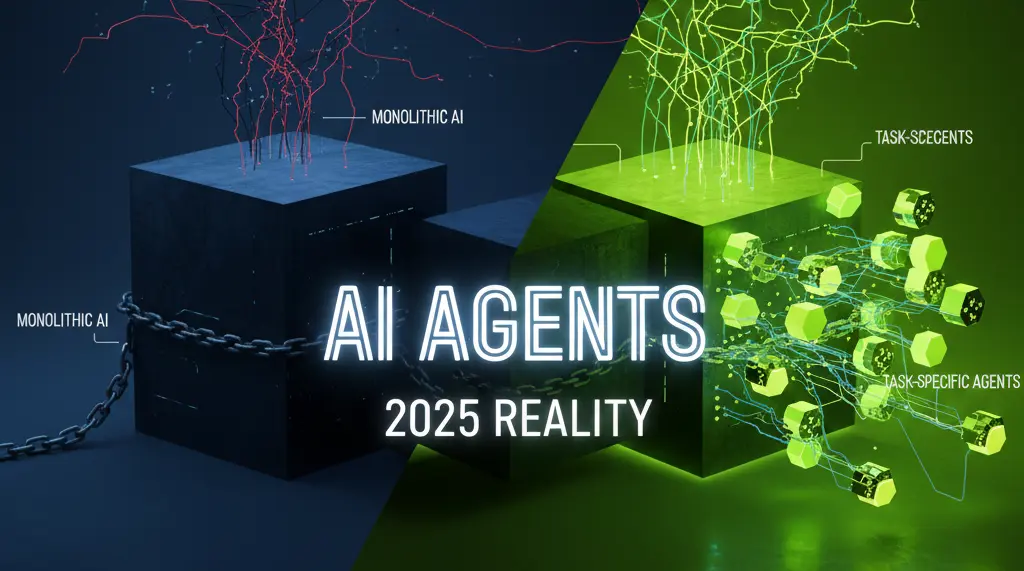
There's a quiet revolution happening in how businesses use artificial intelligence—and it's not what tech giants spent billions marketing to us. Instead of betting everything on massive general-purpose models, smart enterprises are discovering something counterintuitive: smaller, specialized AI agents that do one thing exceptionally well are crushing it where their heavyweight cousins stumble.
Think about it this way. Would you hire a Swiss Army knife to perform brain surgery? Gartner's research suggests 40% of enterprise applications will feature these focused AI agents by the end of 2026, up from barely 5% today. That's not a gradual shift—it's a stampede toward practical intelligence that actually delivers measurable results.
Why Smaller Really Is Better (And Cheaper)
The Numbers Don't Lie About Cost
Here's where things get interesting. GPT-4 costs around $0.09 per request when you add up input and output tokens. Meanwhile, specialized models like Mistral 7B accomplish comparable tasks for $0.0004 per request. That's not a typo—we're talking about running 225 requests for the price of one GPT-4 call. Training costs? Large models can burn through $20 million or more, while their smaller, focused cousins achieve similar specialized performance for one-tenth that investment.
Real ROI That CFOs Actually Care About
Organizations implementing strategic AI agent frameworks aren't just saving pennies—they're achieving 5x to 12x return on investment compared to companies throwing spaghetti at the AI wall. LPL Financial's specialized agents now handle 40,000 interactions monthly, saving $15–$50 per interaction that would've needed human attention. When you can point to that kind of bottom-line impact, suddenly every department head wants their own task-specific agent.
The Market Is Screaming Growth
Follow the Money
The global AI agents market was valued at $5.43 billion in 2024. Industry analysts project it'll explode to $236.03 billion by 2034—that's a 45.82% compound annual growth rate. Another forecast suggests growth from $7.84 billion in 2025 to $52.62 billion by 2030. When multiple research firms independently predict this kind of expansion, investors and enterprises pay attention.
C-Suite Executives Are All In
About 89% of surveyed CIOs now consider agent-based AI a strategic priority, not a nice-to-have experiment. Leading platforms like Salesforce Agentforce, Microsoft Copilot Agents, and Google Vertex AI Agents are winning enterprise budgets because they balance easy deployment with rapid, demonstrable ROI. Nobody's asking "Should we adopt AI agents?" anymore—the question is "Which agents solve our specific problems fastest?"
The Technical Edge Nobody's Talking About
Speed and Sustainability Matter
Small language models require dramatically less compute power and memory, making them faster to train, fine-tune, and deploy. They consume roughly 60% less energy than their larger counterparts—critical as data centers now devour 4% of global electricity. For companies with aggressive sustainability commitments, that energy difference isn't trivial.
Building With Legos, Not Monoliths
Task-specific agents enable what researchers call "Lego-like" composition of intelligence. Instead of scaling up one massive model that tries to do everything mediocrely, you scale out by adding small, specialized experts. This modular approach creates systems that are cheaper, faster, and infinitely more adaptable when business requirements inevitably change. When your sales process shifts or regulations update, you swap out one agent instead of retraining a monolithic behemoth.
Where This Is Actually Heading
Five Stages to Agent Maturity
Industry frameworks identify a clear progression from basic task automation to sophisticated agentic ecosystems. In Stage 2—where most enterprises currently operate—AI agents handle complex, end-to-end tasks autonomously. Picture AI-driven cybersecurity agents that scan network traffic in real time, identify threats, and initiate appropriate responses without waiting for human approval. By 2029, analysts expect at least half of knowledge workers will routinely develop their own AI agents for complex tasks.
The $450 Billion Question
Gartner's best-case scenario suggests agentic AI could drive approximately 30% of enterprise application software revenue by 2035, surpassing $450 billion—up from just 2% in 2025. This transformation shifts enterprise applications from tools supporting individual productivity into platforms enabling autonomous collaboration and dynamic workflow orchestration.
The Hard Truths About Implementation
DIY Doesn't Always Work
While frameworks like LangChain allow massive customization, about 60% of DIY initiatives never scale past pilot stages due to unclear ROI. Organizations face a tough balance between customization capabilities and the engineering resources required to actually ship something valuable.
You've Got Three to Six Months
C-level executives at software companies have a critical three- to six-month window to define their agentic AI product strategy. The industry sits at an inflection point. Organizations that don't plan to develop agentic capabilities risk watching competitors pull ahead as standardized protocols enable seamless interoperability. Early movers aren't just testing technology—they're establishing workflows and competitive advantages that'll be painful to replicate later.

-Who-Wins-the-Satellite-War.webp)


Comments 0
No comments yet
Be the first to share your thoughts!
Leave a Comment